For First-Time Puppy Owners
Stop dragging your puppy through the lobby. Build a repeatable, stress-free route from your apartment door to the sidewalk in just 7 days.
Instant PDF download · Read in one evening · 30-day refund
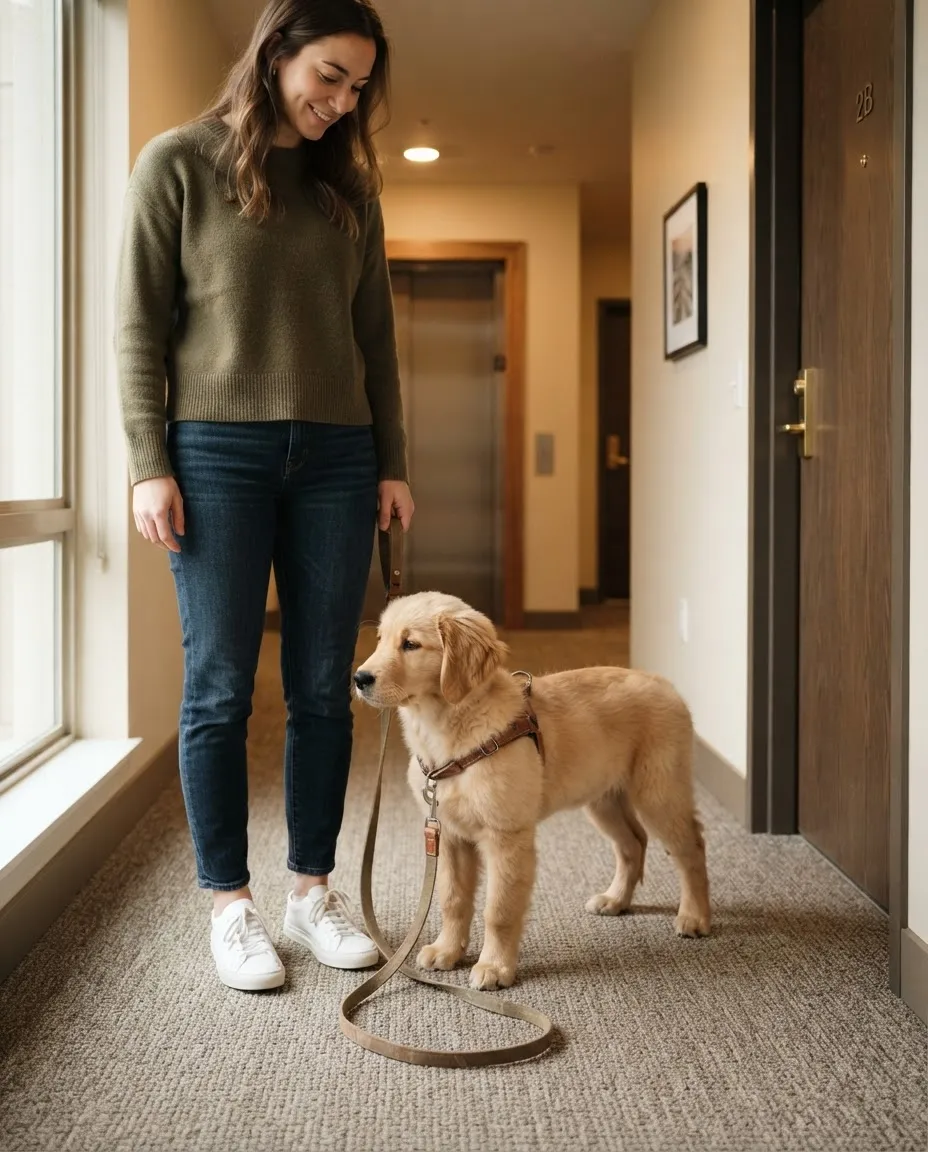
The Hallway Problem
The Stress Starts
Before The Sidewalk
You're not failing, the environment is just hard.
You feel watched. The second your door clicks shut, the hallway becomes a stage. Someone is waiting for the elevator. Someone else's door is opening. You hear yourself apologizing before your puppy has even pulled.
The leash goes tight. One glimpse of the neighbor's terrier and the walk turns into a tug-of-war. Your heels brace, your shoulder climbs toward your ear, and the calm exit you rehearsed disappears in about four seconds.
The elevator never comes. Sixty seconds of standing still with a puppy who is certain the carpet is edible, the door chime is a threat, and the entire building is listening.
None of this means your puppy is untrainable, or that you're doing it wrong. It means the hallway is asking more of your puppy than a hallway should.
The Slack-Leash Indicator
Same hallway. Two very different walks.
The Pull
Tight leash, sharp zigzag tension. You feel it in your wrist before you feel it anywhere else.
The Slack
A soft U of loose leash. Your puppy checks in, you breathe out, and the hallway gets quieter.
One is a symptom. The other is a signal you can build on.
The Route Method
Map A Predictable
Route
Stop practicing the whole trip at once.
Most owners rehearse the entire exit in one go. When it falls apart, they have no idea which part caused it. The Route Method splits the trip into four distinct practice zones, so you can pinpoint exactly where the leash tightens and train only that.
Four small sessions beat one long test. Progress becomes something you can see, not something you hope for.
Four zones. One calm exit.
The Door
Hand on the handle, door open, door closed. Rehearse the threshold itself, with zero expectation of stepping through.
The Hallway
Ten steps out, ten steps back. Note the exact metre where the leash first tightens. That is the distance you train at.
The Elevator
One floor, there and back. Desensitise the doors, the hum and the passing neighbours without adding street pressure.
The Lobby
The final gate. Sliding doors, foot traffic and the street beyond. Only cross when the leash is already slack here.
Inside the eBook
A Framework For
Shared Spaces
A preview from inside the eBook — three of its seven chapters, plus the Route Decision Card you'll use on every trip. The rest of the book walks you from the door to the sidewalk.
Chapter 01
Read the Route, Not the Pull
Most owners watch the leash. The route tells you more. Before you touch the door, walk the path your puppy will take and mark the two or three places where their movement changes.
- Map the threshold, the turn, and the stopping point
- Name what your puppy notices at each one
- Decide your response before the walk begins
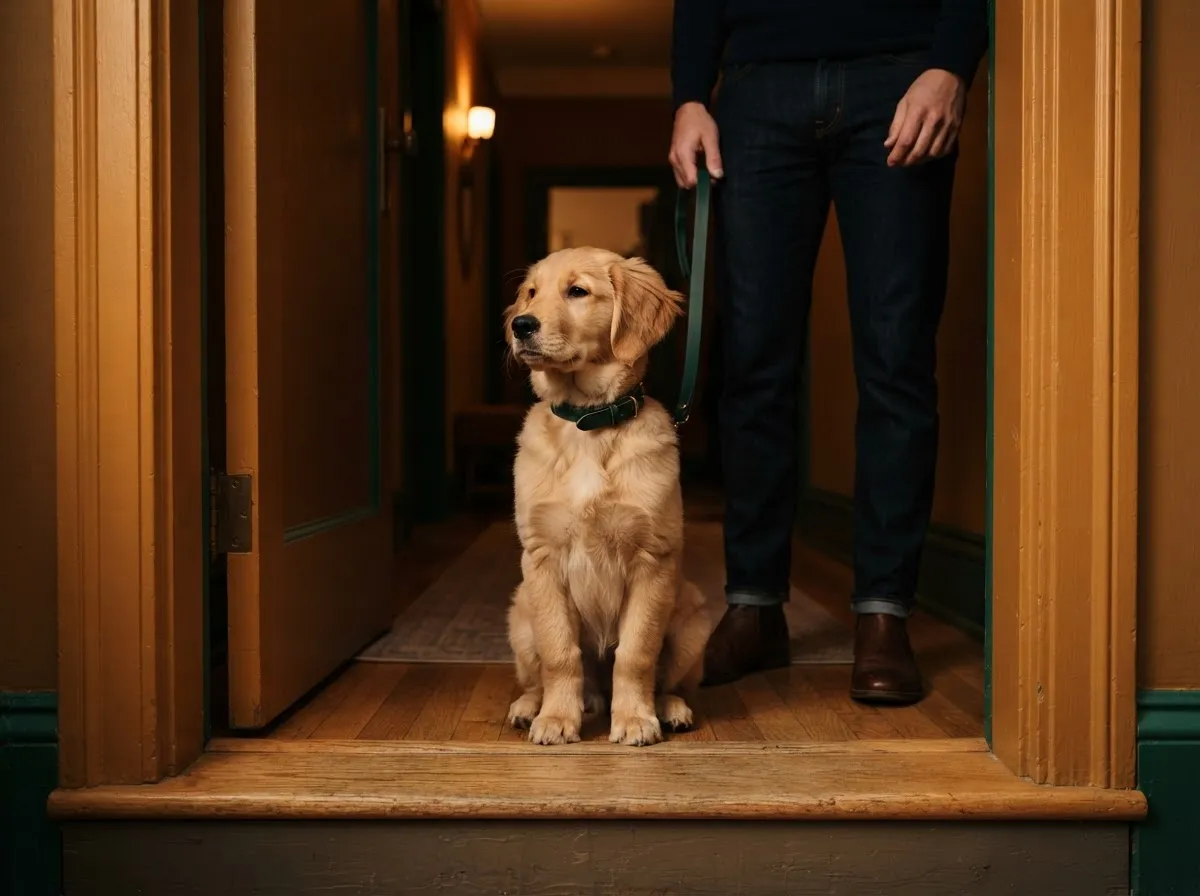
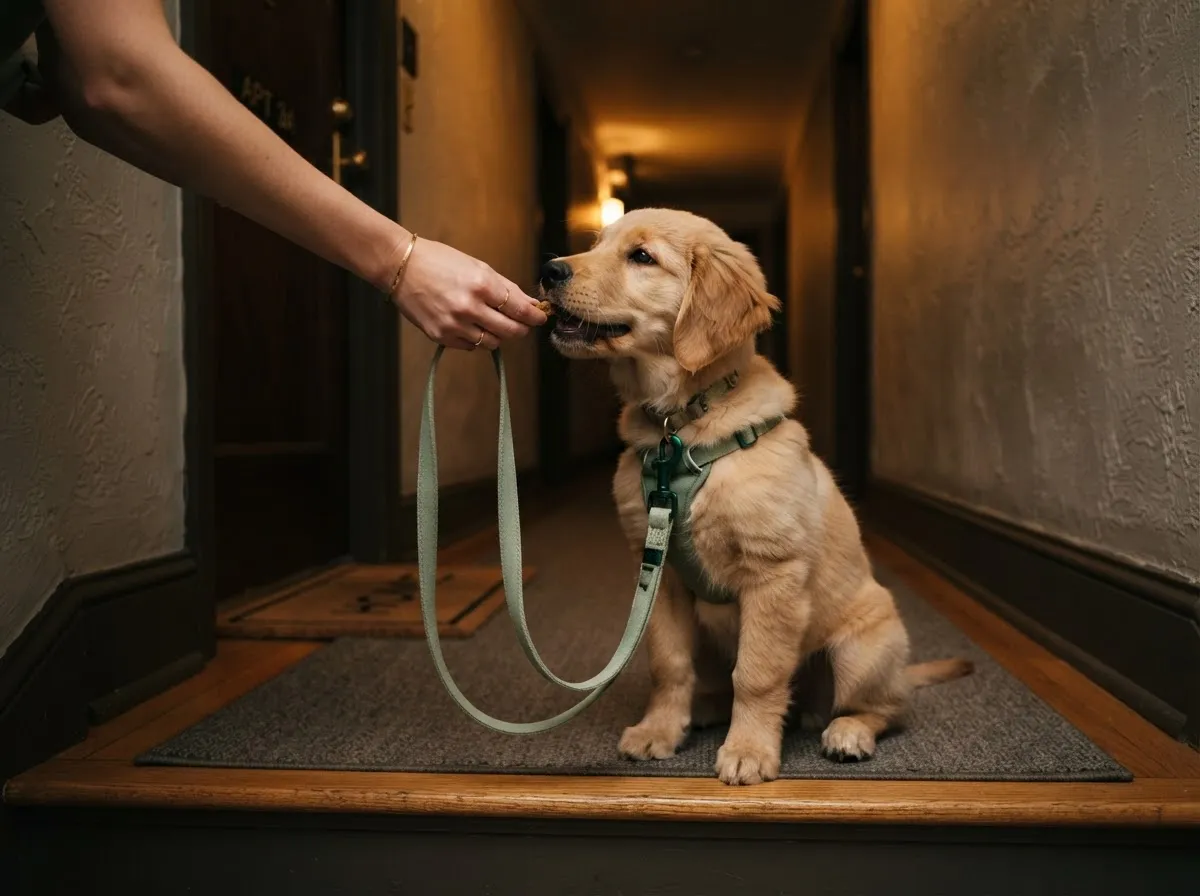
Chapter 02
Reward Two Steps
Indoor prep happens before the hallway, not in it. Two calm steps toward the door earn a treat, two more earn another. By the time the latch turns, the pattern is already familiar.
- Mark and reward every two steps toward the door
- Practise the latch, the pause, and the release
- Keep each session under two minutes
Chapter 05
Manage the Audience
Hallways and lifts have other people in them. This chapter shows you how to time your exit, where to stand when a neighbour rounds the corner, and how to turn a crowded lift into a five-second training rep.
- Time the exit around lift traffic
- Give your puppy a job at the door
- Ask for one calm sit instead of a pull
One look at your puppy tells you which of three moves comes next.
Leash is slack, ears are forward, and your puppy steps out without being asked.
A noise, a neighbour, a stop in movement. Stand still, breathe, let them settle.
Too much at once. Shorten the route, add distance, or take the quiet exit.
THE COMPLETE TOOLKIT
Everything You Need For
A Relaxed Exit
The eBook plus two bonuses, bundled into a single $27 download, so you can step out the door without guessing.
Door to Sidewalk
Trip Record
Practice sheet 12 | Tuesday, 7:40 AM
Route segment I practiced
Hallway, then elevator
Where movement first changed
Leash tightened at the third door
What I chose to do
Pause, wait for slack, continue
Leash mostly slack?
Mostly slack — one reset in the lobby
Next practice
WHAT'S INCLUDED
The Digital eBook
The full door-to-sidewalk method, read on any device.
$27
Door to Sidewalk Trip Record
A fillable worksheet you print and fill in after each trip — detail the route segment, where movement changed, what you chose, and whether the leash stayed mostly slack.
BONUS
The Route Decision Card
Continue, Pause or Make It Easier, decided in seconds.
BONUS
One payment — both bonuses included
$27
Instant download. Print a fresh sheet for every walk, for as long as you need it.
RESEARCH-BACKED METHODOLOGY
Rooted In Veterinary Science
Three leading veterinary behavior programs shape the principles behind every step of the Route.
THE STANDARD
Not just dog tips: behaviorally sound methodology.
Every protocol traces to a published study, not a training trend.
REINFORCEMENT TIMING
Purdue University
Reward the instant the leash softens, so your puppy learns which behavior actually earns freedom.
STRESS-SIGNAL RESEARCH
UC Davis
Their behavior clinic charts early stress cues, so you pause before a hallway tips into overwhelm.
HUMANE HANDLING
Tufts University
Low-pressure handling protocols keep training cooperative, never a contest of strength.
Ready When You Are
Build A Repeatable Routine
Seven days, one practice area at a time. A one-time $27 download that replaces hallway chaos with a routine you can actually repeat.
The 7-Day Promise
Puppy Walks Without the Hallway Pull
$27
One-time payment. No subscription.
Goal: a repeatable routine, not a perfect walk.
Instant access after checkout · 7-day practice plan · Yours to keep
REAL APARTMENT LIFE
Real Apartment
Realities
No method works in a vacuum. Hallways get crowded, puppies get over-excited, and neighbours have places to be. This approach is built for that reality: it teaches you to read the environment, adjust the pace, and choose the calmest option instead of the perfect one.
My hallway is busy at 8 a.m. and 6 p.m. Can this still work?
Yes, and those are the hours the method is written around. It shows you how to claim a quieter window when your building allows it, and how to lower the walk's demands when it doesn't. A crowded hallway isn't a failed session, it's a different kind of session. Two calm metres past a neighbour's door counts, and you'll know how to end there instead of pushing on.
My puppy gets too excited whenever we pass a neighbour.
Excitement is information, not misbehaviour. You get a doorway threshold routine you can run against any wall: pause, ask for a sit, reward the first calm breath, then move. If the neighbour stops to chat, there's a short, friendly script for keeping the greeting brief without anyone feeling brushed off.
What if my puppy freezes at the door and refuses to move?
Freezing usually means your puppy is taking in more than they can process right now. The ebook teaches one decision: Continue, Pause, or Make it Easier, and how to read which one the moment calls for. Choosing easier isn't a setback; it's how the hallway stays a place your puppy is willing to try again tomorrow.
Will this guarantee a perfect walk every time?
No, and we won't pretend otherwise. Puppies have off days, weather turns, and someone will always be moving furniture into the stairwell. What you're buying is a repeatable way to respond on the rough days, so one shaky walk stays one shaky walk instead of becoming the pattern you live with.

Puppy Walk Pro
A calm, science-backed walking method for puppies growing up in apartments. Built with veterinary behavior guidance, made for the hallway, the elevator, and the street outside.